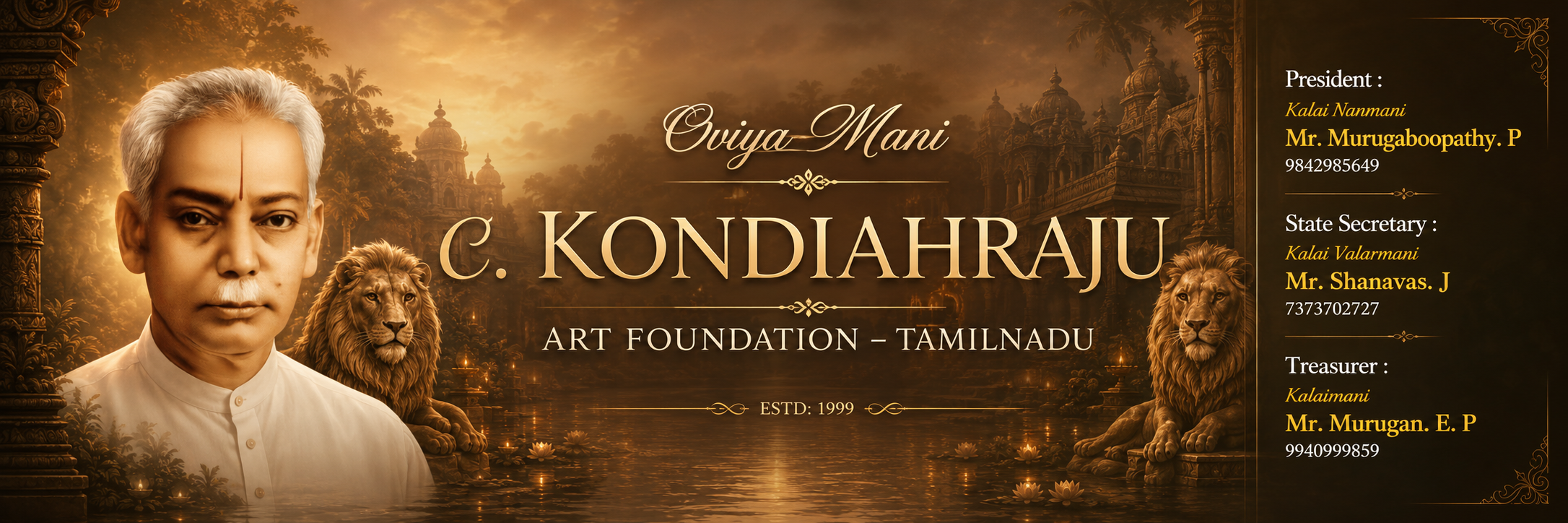
 Kondiahraju Art Foundation
C. Kondiah Raju: The Artist Who Brought Gods to Every Home
The name C. Kondiah Raju evokes a profound sense of cultural significance and artistic mastery. Born in Mylapore, Chennai, in 1898, Kondiah Raju rose to become one of India’s most influential and beloved calendar artists, whose work profoundly shaped how millions of South Indians visualized and connected with their deities, national leaders, and cultural narratives. He is, without a doubt, a true legend.
A Pioneering Visionary in Popular Art:
Kondiah Raju’s legend lies in his unique ability to bridge traditional South Indian painting styles with the emerging medium of lithographic prints. In an era when calendar art was becoming accessible to the masses, he carved a niche by creating vivid, devotional images that adorned puja rooms and small shrines across the Tamil country.
- Master of Divine Depictions: His “Gajendra Moksham,” “Meenakshi Kalyanam,” and countless other religious prints are considered unrivalled masterpieces. Unlike some contemporaries who adopted a more Westernized approach, Kondiah Raju’s calendar art retained the iconic, formal representation of deities reminiscent of traditional temple art and Tanjore paintings, a style deeply rooted in his community’s heritage. This made his work incredibly resonant and relatable to the common person.
- Shaping Public Perception: So pervasive were his prints that for many South Indians, the visual representation of gods, goddesses, and even leaders of the Indian freedom movement or contemporary political figures, was through Kondiah Raju’s art. He played a crucial role in shaping mass visual culture and religious iconography.
- Innovation in Medium: He pioneered the introduction of German tempera colors in South Indian calendar art, later embracing Camlin watercolours, which allowed for greater speed and ease in execution. This technical innovation, combined with his artistic prowess, made his work widely reproducible and accessible.
A Life Dedicated to Art and Community:
Kondiah Raju’s journey was marked by both artistic brilliance and a deeply spiritual and austere personal life.
- Gurukula Tradition: He established the “Devi Art Studio” in Kovilpatti, where he imparted his knowledge and skills to numerous disciples through the age-old gurukula system. Many of his students, like T. S. Subbaiah and Mu. Ramalingam, went on to become master artists in their own right, a testament to his mentorship and the lasting legacy of his teachings. His students fondly called him “Anna” (Elder Brother).
- Artist-Saint: Despite earning a fortune through his commissions, Kondiah Raju lived a remarkably simple life, reportedly never marrying and distributing his wealth to others. His pupils often referred to him as an “artist-saint,” a reflection of his dedication to art and his humble, selfless nature. He even turned down a government award in 1971, prioritizing his art and simple life over accolades.
- Beyond Religious Art: While renowned for his devotional works, Kondiah Raju and his students also contributed to advertisements and commercial art, further solidifying his influence on public visual culture.
International Recognition:
Kondiah Raju’s significance extends beyond India. His prints have been collected internationally and are archived in prestigious institutions like the Victoria and Albert Museum (UK) and the H. Daniel Smith Poster Archive at Syracuse University library. In 2005, the National Centre for Arts in Delhi and the Italian Embassy Cultural Institute jointly acknowledged him, along with Raja Ravi Varma, for introducing lithographic paintings for the first time in India, showcasing his pivotal role in art history.
C. Kondiah Raju’s contribution to popular art, religious iconography, and the training of future generations of artists solidifies his place as a true legend, whose art continues to resonate and inspire.